Semrush just launched an official ChatGPT app. Not a plugin. Not a workaround. A direct integration that puts Semrush data inside ChatGPT conversations.
If you’re already living in ChatGPT for research, content planning, or strategy work, this changes how fast you can access competitive data. If you’re not, it probably doesn’t matter yet.
Here’s what it actually does, what it doesn’t, and who should care.
What This Actually Is
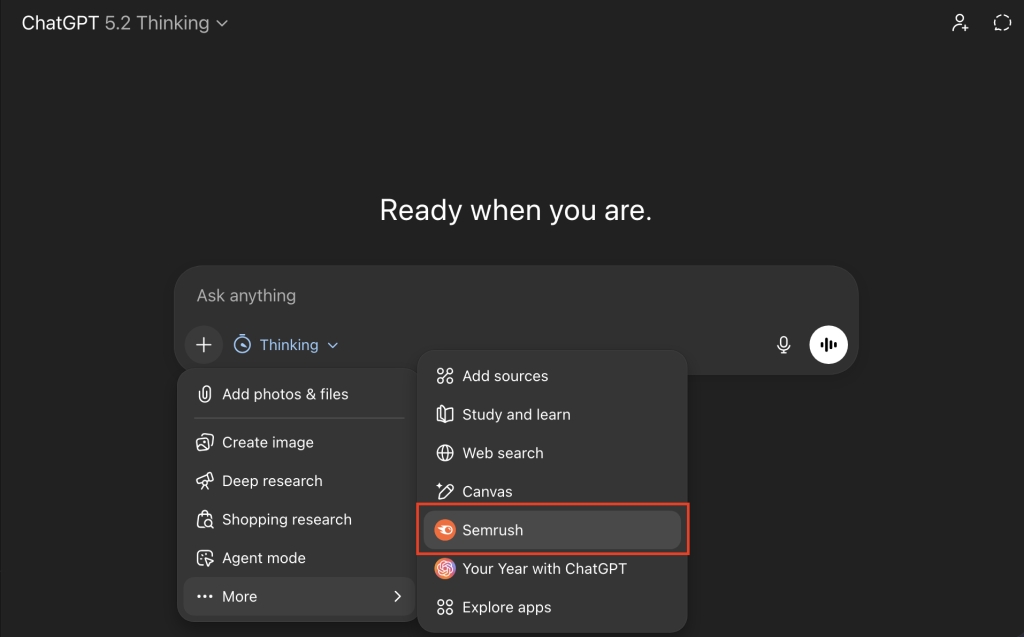
Semrush launched an official app in ChatGPT on December 17th. This is a first-party integration built using OpenAI’s Model Context Protocol (MCP) infrastructure. You’re not installing a third-party plugin or running a hacky workaround. It’s official, and it works like any other ChatGPT app.
Here’s the basic setup: If you have a Semrush subscription (Enterprise, Business, Pro, or Plus), you authenticate once in ChatGPT. After that, you can pull live Semrush data directly into your ChatGPT conversations without switching tools.
Let me be clear about what this is and isn’t:
This does NOT replace Semrush. You’re not getting the full platform experience in ChatGPT. You’re getting faster access to specific data points.
This does NOT automate SEO. If you’re expecting ChatGPT to “do SEO for you,” this won’t help. You still need to know what questions to ask and how to interpret the answers.
It DOES make certain data faster to access. If you’re already using ChatGPT for research or strategy and you’re constantly switching tabs to check Semrush, this eliminates some of that friction.
What You Can (and Can’t) Access
Here is what is currently available through the ChatGPT app:
Available data:
- Domain analytics (traffic estimates, visibility metrics)
- Keyword data (search volume, difficulty, rankings)
- Competitive metrics (domain comparisons, market positioning)
- Backlink data (link profiles, referring domains)
- Traffic estimates for domains and subdomains
Not available:
- Full reporting suite with custom dashboards
- Position tracking projects
- Site audit tools and technical SEO diagnostics
- Advertising research tools (PPC, display ads)
- Content marketing platform features
Semrush hasn’t published a complete feature matrix yet, so some of this is based on what early adopters are reporting and from my own use. If you need a specific Semrush tool for your workflow, check the documentation before assuming it’s available in ChatGPT.
The real limitation isn’t what data you can access. It’s that you still need to know what to ask. This isn’t intelligence. It’s faster data retrieval.
Why This Matters: Workflow, Not Magic
The value here isn’t “AI SEO.” It’s fewer tool switches.
Let me show you a concrete example:
Scenario: You’re writing a content brief for “best project management software.”
Your old workflow might look something like this:
- Open ChatGPT to start drafting your outline
- Switch to Semrush to check search volume for “best project management software”
- Switch back to ChatGPT to note the volume
- Switch to Semrush again to see who ranks in the top 3
- Switch back to ChatGPT to add competitive context
- Switch to Semrush to check related keywords like “project management tools,” “project management software for small business,” “free project management software”
- Switch back to ChatGPT to incorporate those variants
- Switch to Semrush to look at what sections the top-ranking competitors are covering
- Switch back to ChatGPT to adjust your outline
- Switch to Semrush to check the domain authority of competitors to gauge difficulty
- Switch back to ChatGPT to finalize your brief
That’s 11 steps with 6 tool switches just to build one content brief.
New workflow:
- Stay in ChatGPT and ask: “What’s the search volume for ‘best project management software’ and who ranks in the top 3?”
- Ask: “What are the top 5 related keywords by search volume? By transactional intent?”
- Ask: “What’s the domain rating for the top 3 ranking sites?”
- Ask: “Show me traffic estimates for the #1 ranking page”
- Use that data to build your brief without leaving the conversation
It cuts the steps down, and you never broke context. Faster, not revolutionary.
This pattern applies to several common scenarios:
Checking competitor domains mid-strategy call: Instead of saying “hold on, let me pull up Semrush,” you can ask ChatGPT for the visibility data while you’re already talking through the strategy.
Validating keyword assumptions during content planning: When you’re building a content calendar and want to quickly verify search volume or difficulty, you can stay in the same conversation instead of opening a new tool.
Quick visibility checks without opening new tabs: If you’re in a ChatGPT conversation about competitive analysis and want to see how a domain is performing, you can get that data without breaking your flow.
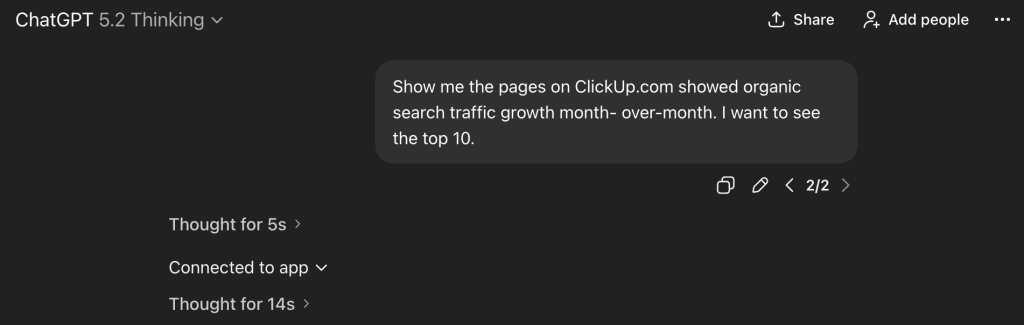
Identifying growth opportunities from competitor traffic: Ask something like “Show me the pages on ClickUp.com that showed organic search traffic growth month-over-month. I want to see the top 10.” You get a ranked list of what’s working for competitors without exporting reports or building custom dashboards.
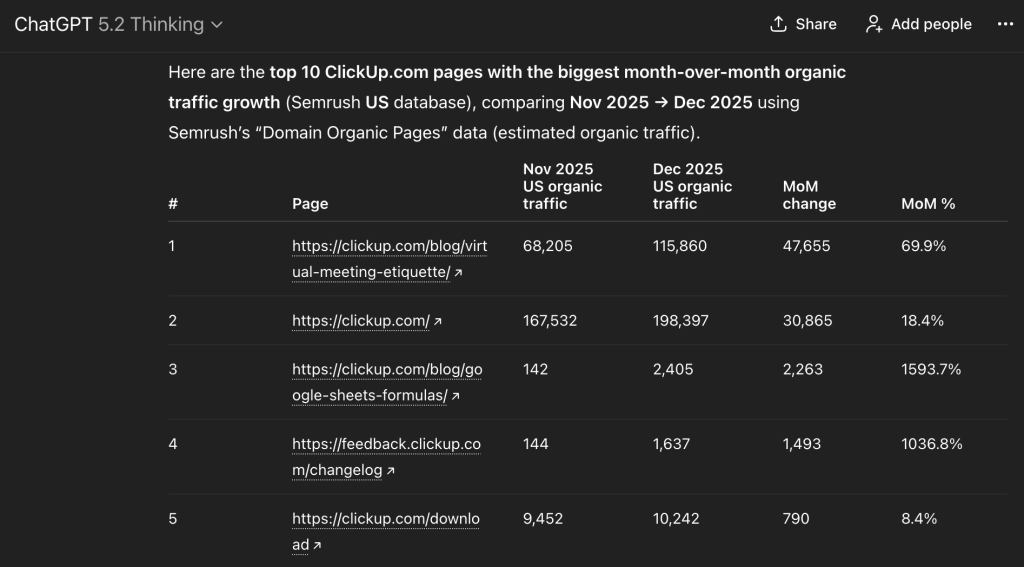
Early-stage opportunity exploration: When you’re researching a new topic or market and want to quickly gauge search demand and competition, you can explore within the same interface you’re using to think through the opportunity.
You could also try so
The key word in all of these is “quick.” This is best for exploration and speed, not final decisions. Serious work, building comprehensive reports, running full competitive audits, tracking positions over time, still happens in Semrush proper, combined with other tools.
Limitations (And Why That’s Fine)
Not all Semrush features are available in ChatGPT. You can’t build custom dashboards, set up automated reports, or access the full suite of tools you’d use for a complete SEO audit.
There’s no deep customization. You’re asking questions and getting answers, not configuring complex queries with filters and parameters.
You can’t export data directly or save reports for later. The data shows up in your conversation, and that’s it.
One significant limitation: this integration doesn’t work in custom GPTs. You can only use it in standard ChatGPT conversations. If you’ve built custom GPTs for SEO workflows, keyword research assistants, content brief generators, competitive analysis bots, you can’t add Semrush data to them. If that ever changes, this integration becomes much more powerful for SEO. But right now, it’s limited to the base ChatGPT interface.
And the biggest limitation: you still need to know what questions to ask. ChatGPT won’t proactively identify opportunities or suggest analyses. It responds to what you request. If you don’t know how to use Semrush data strategically, having it in ChatGPT doesn’t change that.
Think of it as a sharp knife, not a full toolbox. It’s excellent for what it does, but it’s not meant to replace the entire platform.
Who Should Care Right Now
This is useful for:
Consultants and in-house SEOs already living in ChatGPT. If you’re using ChatGPT daily for research, strategy, or content planning, and you have a Semrush subscription, this removes friction from your workflow.
Content strategists doing research in ChatGPT. If you’re building content briefs, keyword clusters, or topic maps in ChatGPT and you’re constantly switching to Semrush to validate ideas, this saves you time.
Anyone who currently switches between ChatGPT and Semrush multiple times per day. The more often you bounce between these two tools, the more time this saves.
This doesn’t matter (yet) for:
Teams without existing Semrush subscriptions. This isn’t a standalone product. It’s an interface layer for Semrush data. If you don’t already pay for Semrush, this doesn’t give you access.
Beginners expecting AI to “do SEO for them.” If your mental model is “AI will automate SEO,” this will disappoint you. It’s a data access tool, not an autonomous agent.
Anyone not already using ChatGPT as part of their workflow. If you don’t currently use ChatGPT for SEO work, this integration doesn’t create a reason to start. The value is in workflow consolidation, not in unlocking new capabilities.
The Actual Takeaway
This isn’t revolutionary. It is useful for a specific workflow pattern.
If you’re already bouncing between ChatGPT and Semrush five times a day, this saves you time and keeps you in flow. You’ll notice the difference immediately.
If you’re not, it probably doesn’t change anything yet.
The bigger pattern here is that SEO tools are moving into conversational interfaces. Data is becoming more on-demand and contextual. Tools are integrating into workflows instead of forcing workflows into tools.
But the winners won’t be the ones who use AI tools the most. They’ll be the ones who integrate them intelligently into how they already think and work.
This Semrush integration is a step in that direction. A small step, but a real one.